Planned Upgrades
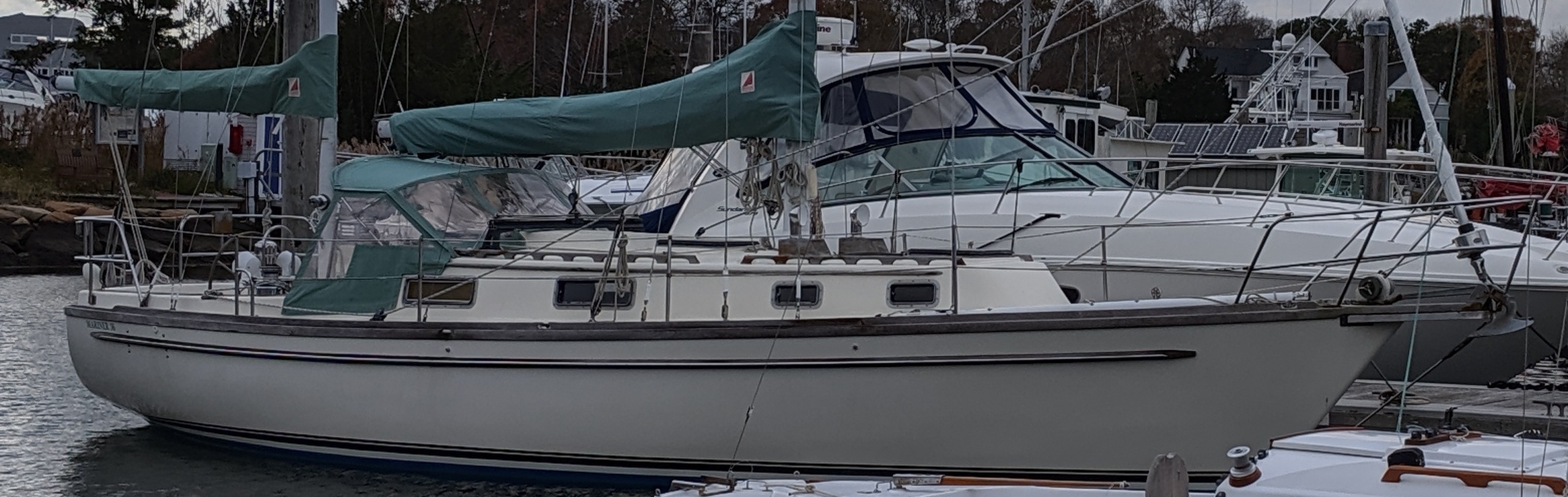
Quite a bit of work is planned for this vessel. The expense will likely exceed the original purchase by a factor of three or four. General condition and measurements at time of purchase are described in the Condition and Measurements web page.
A major part of this work involves repowering from diesel to electric. Auxilliary power as purchased was provided by a Universal Atomic Four Diesel engine. The diesel will be replaced with solar, battery, and electric auxilliary. This requires among other things removing the engine driven refrigeration and replacing that with electric. Details of the non-trivial task of removing the diesel is described in the Diesel Removal web page.
Fiberglass Repair and Painting
The Marine Survey Findings identified parts of the sidedecks on either side near the chain plates where the decks have high moisture and the skin of the deck has detached from the coring.
The sidedeck repair was done by Kent Richardson of Richardson's Marine in Chatham, MA. Kent also completed other fiberglass repair and soda blast, fairing, barrier coat, and bottom painting below the waterline. The topsides were in good shape so they were buffed rather than painted. Completed fiberglass work is described in the Completed Fiberglass Work and Painting web page.
Miscellaneous Small Projects
Miscellaneous completed work includes steering pedestal changes, rebedding, refinishing, and joinery, and rigging improvements planned as time permits. Some of this work might be done after the boat is on the water.
Description of Planned Major Work
The current plan is to do major work in phases.
- Completely rewire the boat.
- Replace entire plumbing system.
- Replace diesel engine with electric auxilliary
- Install shore power charger
- Install wind charger
- Add Li-ion battery banks and solar controllers
- Replace instruments and displays
- Replace missing autopilot
- Replace engine driven with electric refrigeration
- Major increase in solar panel capacity
- Possibly add air conditioning and heat
- Replace the manual windlass with electric
- Install a watermaker
- Install a dive compressor
Electrical System Rewire
The original electrical system was a mess with wires unnecessarily run through the bilge, including AC, a mix of wire sizes, poor routing and a lack of labeling, and poor connections in places. It quickly became apparent that a complete electrical system replacement was called for.
Plumbing System Replacement
The fresh water system was hopelessly clogged with black dead algae, undersized hoses, small expansion tank with burst bladder, and poorly located fresh water pump. Routing of the plumbing hoses could be improved. A decision was made to replace at least all lines, pumps, expansion tank and water heater. The plumbing fixtures will likely be replaced as well.
Electric Auxilliary
The diesel is being replaced with an electric auxilliary. The Electric Auxilliary Propulsion web page provides details on the decision and progress.
Shore Power Charger
While not major work, the shore power charger will be the first charging source to be of any use. While on the hard with masts down, the wind charger cannot generate power and with masts down, measurements relative to the boom cannot be completed, preventing completion of the solar mount.
Wind Charger
The wind charger can be mounted on the mizzen mast without the charger itself and connectors wired such that when the masts are raised the connections are easily made.
Battery Bank Upgrade
A major battery bank upgrade with related charging electronics will be a major expense. The Battery Selection web page provides options considered and quantifies costs as well as weight and space savings. The Battery Charging Plans web page describes how the battery banks will be charged.
Instruments and Displays
Instruments at time of purchase where ancient but mostly functional. The Furuno radar is ancient featuring a bulky CRT. The Garmin 182C chartplotter is adequate but lacks ability to network. The Datamarine depth and knotlog are ancient. The wind instrument is the most recent but still quite old. These instruments will be replaced with a Raymarine Axiom 9 to handle GPS and display, a new combined speed and depth transducer, plus new radar and wind instrument.
Autopilot
Neither and autopilot or an emergency tiller were installed at time of purchase. The Autopilot Selection and Installation web page describes the autopilots considered. The 24V version of the Raymarine T70158 EV-200 Linear Electric Motor autopilot is the current favorite. The EV-400 might be used to improve the ability to handle heavy weather.
Refrigeration
Replacement of the refrigeration is a prerequisite for removal of the diesel. The Electric Refrigeration web page provides an analisis of electric refrigeration and provides details including options and power needs.
Solar Panel Upgrade
The Solar Panel Selection web page described the solar panels considered. The solar panels will require a solar panel mounting structure between the traveller and mizzen mast and below the level of the boom. The Solar Panel Mounting web page describes the placement and design of a solar mount.
Air Conditioning and Heat
Air conditioning and heat is a bit of a luxury on a small yacht due more to its high power draw than to its cost. The Air Conditioning and Heat web page provides an analysis of marine A/C and heat options and looks at some options and installation considerations.
Replace Windlass
The Vetus windlass is probably original. It was a manual windlass. The aluminum body is corroded and crubled when removed. A 24V unit will replace it. Little research has been done on this.
Install a Watermaker
A watermaker would be a nice cruising addition given the limited availability, high cost and poor sanitation of drinking water available in parts of the Caribbean and other parts of the world.
Install a Dive Compressor
A dive compressor onboard is a great convenience and for scuba in remote places might be a necessity. Costs range from $1,500 to $20,000 with most likely cost being in the $3,000-$5,000 range.
Major Costs
Major costs are listed for each of the planned major work items. Most installation will be owner installed but some work such as fabricating a stainless steel solar panel mount will have to be contracted out. Items that have already been purchased are marked in green.
-
Electric propulsion:
-
QuietTorque 10.0:
$4,995
-
QuietTorque 10.0:
-
Shore power charging:
-
Delta-Q IC-1200 charger
w/ programming:
$700
-
Delta-Q IC-1200 charger
w/ programming:
-
Wind charging:
- AIR Breeze 48V, carbon fiber
blades, mounting:
$2,000
- AIR Breeze 48V, carbon fiber
blades, mounting:
-
Battery banks:
- 24V 75Ah LBP battery:
$1,300 each; 10@ $13,000 - 12V 100Ah LBP battery:
$900 each; 2@ $1,800 - PS-MPPT-25 solar controller:
$318 each; 2@ $640 - TS-MPPT-30 solar controller:
$382 each; 2@ $760
- 24V 75Ah LBP battery:
-
Autopilot:
- Raymarine T70158 EV-200 Linear: $3,300
-
Refrigeration:
- Sea Frost with two plate: $2,400
- Additional costs: estimated $600
-
Solar:
- Panasonic VBHN340SA17 340 Watt:
$338 each; 2@ $680 - Solar panel SS mount: unknown cost
- Panasonic VBHN340SA17 340 Watt:
-
Instruments:
- Raymarine Axiom 9 chart plotter:
$1,000 - Raymarine DST-800 transducer:
$500 - Raymarine Radar:
$1,800 - Wind Transducer: $500
- AIS transceiver: $1,000
- Raymarine Axiom 9 chart plotter:
-
Windlass:
- unknown brand: unknown price
-
Watermaker:
- unknown brand: unknown price
-
AC/heat:
- Mabru Marine Air Conditioner: $5,700
-
Dive compressor:
- unknown brand: unknown price
Cumulative totals of prior major expenses (to nearest $100 or round up):
- Electric propulsion: $5,000
- Wind and shore power charging: add $2,700 = $7,700
- Battery banks: add $16,200 = $23,900
- Solar (panels only): add $700 = $24,600
- Instruments: add $3,300 = $27,900
Cumulative totals of remaining major expenses (to nearest $100 or round up):
- Autopilot: $3,300
- Refrigeration: add $3,000 = $6,000
- Instruments: add $1,500 = $7,500 + unknown
- AC/heat: add $5,700 = $13,200
- Solar panel mount: add unknown = $13,200 + unknown
- Windlass: add unknown = $13,200 + unknown
- Watermaker: add unknown = $13,200 + unknown
- Dive Compressor: add unknown = $13,200 + unknown
With AC/heat the total of major costs will likely be under $40,000 allowing for the cost of the solar mount which is unknown at this time. With the costs of miscellaneous electrical and plumbing equipment the grand total could exceed $50,000. Many of the costs have been rounded up. Some estimates are little more than guesses. These estimates assume owner installation.
Planned Work Sequence
The planned work is a set of large undertakings and large costs that if done together would be a huge undertaking and cost. For this reason the work will be broken up in phases. The planned fiberglass work and painting, and other work including steering pedestal changes, rebedding, refinishing, and joinery, and rigging improvements will be completed as time permits and is not included in the list below. Some of the above work items are prerequisites to the list below where mounting is needed.
-
The Electric Yacht QuietTorque 10.0 Electric Motor has been purchased. The MaxProp propeller was sent out and has been reconditioning. The prop shaft was bent enough to require replacement. A new cutlass bearing, shaft seal, the new prop shaft, and the prop have been installed. The motor has not been installed.
-
The Delta-Q IC-1200 charger has been purchased and has been programmed for the 48V batter bank. The shore power charger has not been installed.
-
The AIR Breeze 48V has been ordered and delivered. The wind charger will be mounted on the mizzen mast but will not be useable until masts are raised.
-
The battery banks have been purchased but not yet installed. This is described in the Battery Selection web page. The charge controllers have been purchased.
-
A Raymarine T70158 EV-200 Linear Autopilot will be purchased and installed. This is somewhat of a must have for single handing. After the motor goes in, the bilge aft of the motor will be repainted including the new mount for the autopilot.
-
A Sea Frost BDxp 24V refrigeration system will be installed. This draws a maximum of 3.9A and 2.7A at medium power. At medium power and 50% duty cycle, two 75Ah batteries would provide 110 hours (more than four days) of operation.
-
Two Panasonic solar panels have been purchased and will be installed. The difficulty will be in creating a mounting structure for the solar panels. Stainless steel tubing will be used. The existing solar controller cannot be used and so two new TS-MPPT-30 solar charge controllers were purchased with the battery banks.
-
A 24V windlass will be installed. This is time consuming but not complicated. Wiring runs will be a challenge and will be on the starboard side unless it proves too difficult to run wires past the navigation station.
-
The best location for a watermaker is near the galley where the controls will reside unless an electronically controlled unit with remote control panel is used. An available location is on the either the starboard or port side far aft. Either side is relatively inaccessible and a distance from the galley.
-
Whether AC/heat is installed is not certain. It depends largely on where cruising is most often done and whether installation can be accomplished without major forward cabin changes. The Mabru Marine unit is the current top contender and the model being considered is a very efficient 12V 7000 BTU model.
-
A dive compressor is likely to be a late addition and will very likely be installed once on the water.