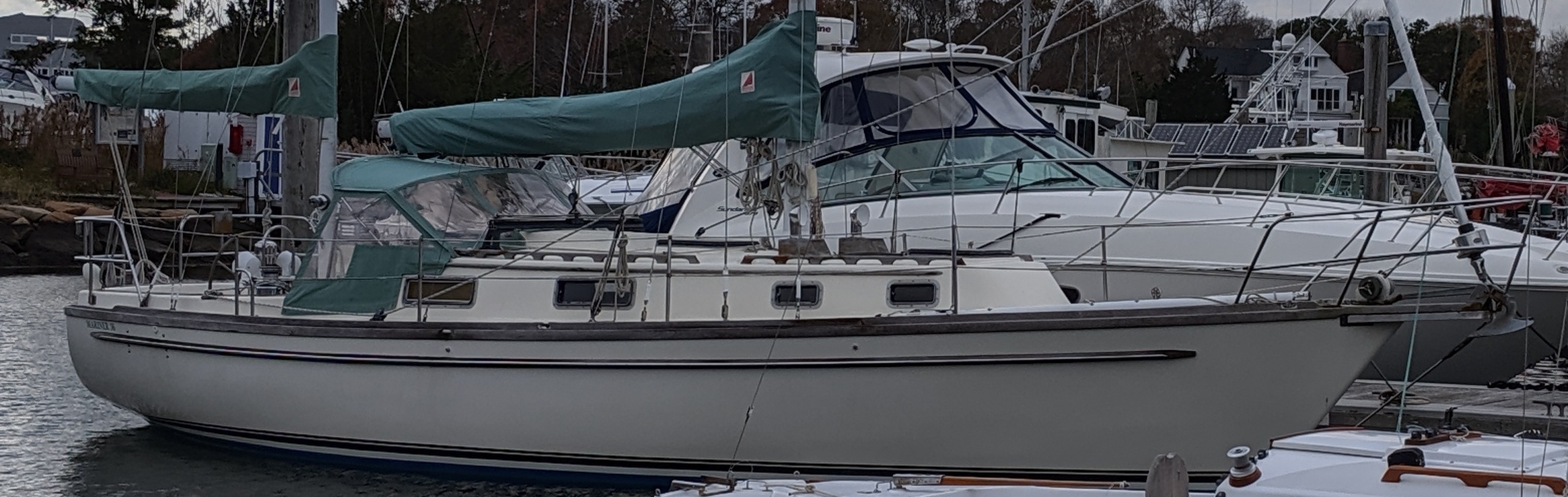
Radar Replacement
The old radar was removed in 2020 and a new radar purchased. The new radar has yet to be installed.
Removing the Old Radar
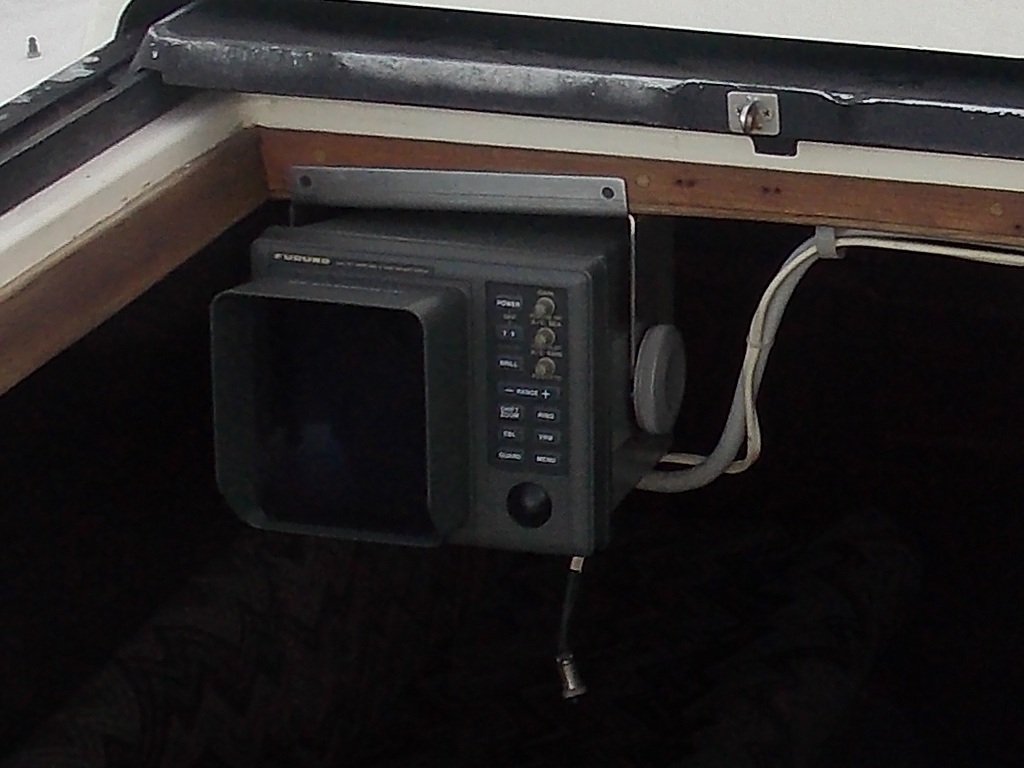
The old radar dates back to circa 1980. It had a dedicated 7" monochrome CRT display which was mounted in the companionway openning, providing an obstacle to entry and a head injury risk. The old radome was large, 24" in diameter, and heavy. It was also power hungry, with a 3kW transmitter. It had been mounted just over half way up the mizzen mast, riveted in place.
The mount for the radar display had been broken by the previous owner during sea trial. The previous owner used it to support his weight when the boat was hit by a wave while he was going down the companionway. That location won't be reused but some trim repair is needed.
The rivets on the radar mount on the mizzen mast were drilled out and the radome and its fixed mount were removed, leaving over a dozen hole in the mizzen mast. The new mount will not fit this hole pattern.
The New Radar
In May 2020 a new radar and mount was purchased. The mount is a Scanstrut Self Levelling Radar Mount (LMM-1) which pivots to keep the radar level when the boat is heeled. A Raymarine Quantum Q24C CHIRP Wifi Radome was purchased after considering other models. The radome has WiFi capability which will not be used and a RayNet connection (NMEA-2000 with proprietary connectors) plus a separate power connector. Power input is either 12V or 24V, accepting 9V-36V. Power disipation is 6W in standby and 17W when in use.
The Scanstrut LMM-1 mount costs just under $750 and the Radome costs about $1700 at the time of purchase.
There is no dedicated display. The chartplotter serves as the radar display using the RayNet connection (or NMEA-2000 with an adapter cable). OpenCPN also supports this radar.
New Radar Installation
The new radar will be mounted on the mizzen mast just below the wind generator low enough that the radar won't interfere with the blades and will have minimal effect on air flow.
The Quantum 2 Installation Instructions list RayNet cable options on page 93. RayNet cables are available from Defender.
The wind generator has three AWG #10 wires. The radar has two AWG #10 wires plus a RayNet cable with a somewhat bulky connector. This will easily fit through the mast with PVC conduit installed to reduce wire slap inside the mast. The difficulty will be getting these wires through the mast step on the cockpit floor and then out the steel compression post. There is a small openning in the front of the compression post for mast wires. This openning will be enlarged and a length of PVC conduit passed through this hole and then up into the mizzen mast. If the conduit extends above the coamings and is well sealed at the cockpit floor, no water will enter if the cockpit is flooded.
The RayNet cable will be longer than others and led to a RayNet hub in a more dry location, likely in the space over the pilot berth. The five AWG #10 wires will be led to 30A terminal strip (oversized for the wind generator) so that wires can be easily reconnected when stepping the mast.
The mizzen mast, wind generator and the radar and mout have been at Belmont Boatworks since early 2023 when Belmont Boatworks was going to install them when they got the chance. They may have long ago forgotten about these. These will be returning home, hopefully this year (it is now Nov 2025) with installation on the mast the following spring. The cockpit and cabin wiring may wait a bit longer.