Battery, Charging and Load Wiring
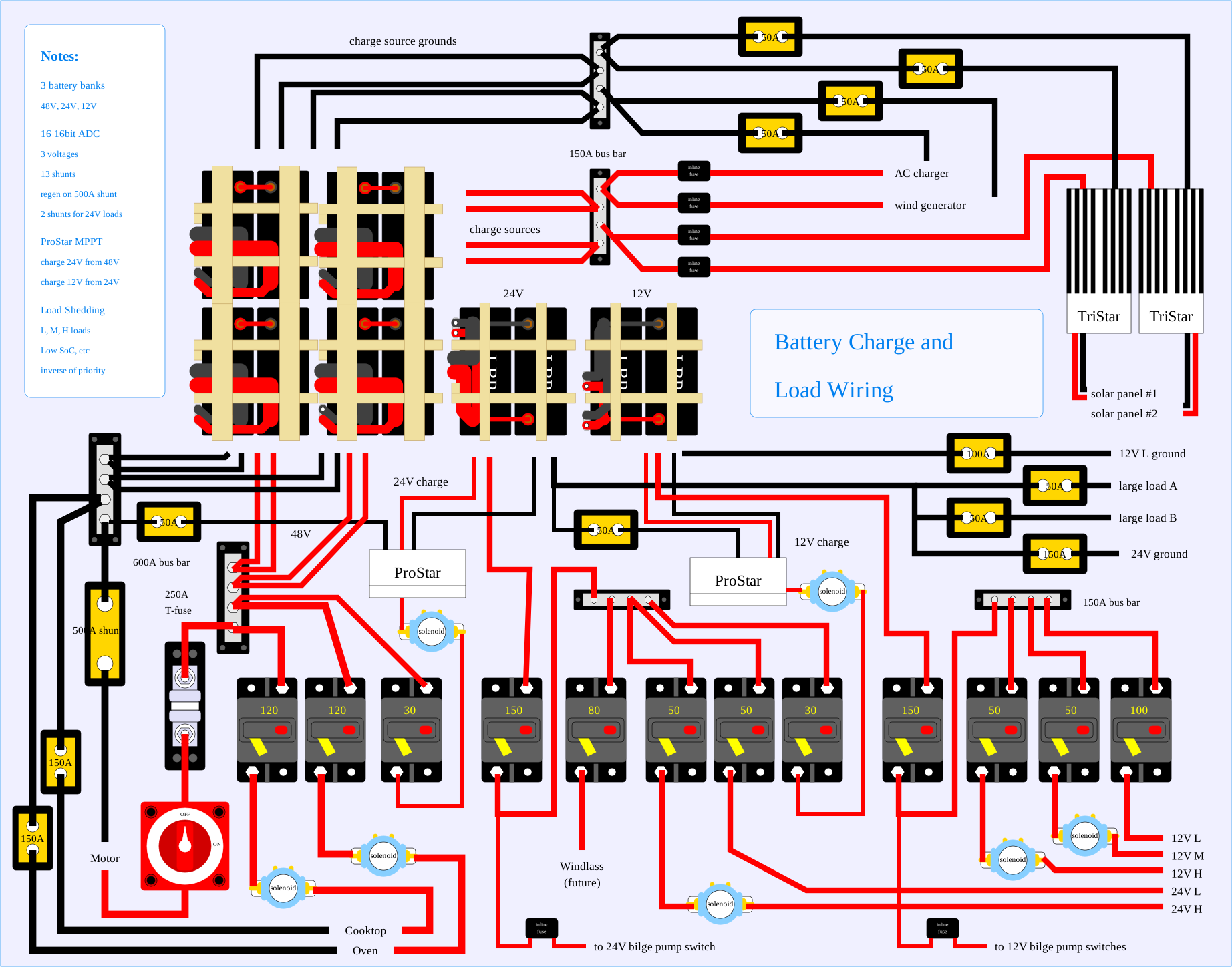
There are three battery banks: 48V, 24V, and 12V. Each has a charging side and load side so that the charging and load can never be connected together without a battery. Details on the battery installation plan and battery wiring can be found on the Battery Installation Plan web page. Details on the charge controllers can be found on the Charge Controllers page.
The high current charging and loads will be handled with bus bars, battery switches, and battery protectors. The battery protectors shut off when a low battery voltage is detected and turn back on when battery voltage recovers, with some hysteresis in the voltage threshholds. The 24V and 12V load side bus bars and battery protected bus bars will be connected to the electrical panel for distribution to sets of lower current loads.
Bus bars and primary charge and load wiring
A total of eight load buses will be used, designated by voltage and priority. The priorities are LSOC for loads available at any state of charge, MSOC for loads that will become unavailable when battery protectors sense low battery voltage, and HSOC (high voltage) for loads that are only available when the battery has a relatively high state of charge. Only 12V has a MSOC. The bus bars are 48V LSOC, 48V HSOC, 24V LSOC, 24V HSOC, 12V LSOC, 12V MSOC, and 12V HSOC. In some cases where there is a single load for a given designation that load may be connected to a battery switch or battery protector directly rather than using a bus bar.
Each battery module will have separate charge and load ground cables. There are six modules, so 12 ground cables from the batteries. Two or three 600A x 4 bus bars will be used. Grounding is discussed in greater detail in the Grounding and Bonding web page.
48V Charging Bus
Each battery module will also have a charging and load positive side. The four 48V modules charging positive cables will lead to a 150A x 4 48V charging bus bar. Also connected to this bus bar is a battery switch labeled "48V charging" and second 48V charging bus bar where the two solar panels, wind generator when installed, and AC charger will be connected.
Each charging source will be separately fused. Each source will have a separate charging shunt to allow monitoring of the individual charging sources. Each of the solar panels will be connected to a separate charge controller. The difference in solar panel outputs should provides insights into the effects of shading on the panels.
48V Load Bus
The 48V module load positive cables will be lead to a 600A x 4 bus bar. Also connected to this bus bar will be a a battery switches and a 40A circuit breaker. The battery switch will be labeled "48V load". The circuit breaker will be labeled "24V charging". The 48V load switch will only be connected to a fuse and then the auxilliary propulsion motor at this time. The 24V charging breaker will be connected to a battery protector and then Morningstar Prostar 25A MPPT charge controller, then the 24V charging single positive battery cable.
| Major 48V Loads and Charging Feed | |||
| V | A | type | desription |
| 48V | 300A | Hiitio breaker | 48V total loads including motor |
| 48V | 200A | Hiitio breaker | 48V loads excluding motor |
| 48V | 250A | Class-T Fuse | auxilliary propulsion electric motor |
| 48V | 150A | Series 285 breaker | solenoid and cooktop/oven inverter |
| 48V | 30A | Series 285 breaker | solenoid and 24V charging |
| Major 24V Loads, Panel Feeds and Charging Feed | |||
| V | A | type | desription |
| 24V | 200A | Hiitio breaker | 250A bus for 24V total loads |
| 24V | 100A | Series 285 breaker | windlass (future) |
| 24V | 150A | Series 285 breaker | 24V 1800W galley inverter |
| 24V | 150A | Series 285 breaker | 24V 1800W vanity inverter |
| 24V | 150A | Series 285 breaker | 24V 1800W heat pump inverter |
| 24V | 100A | Series 285 breaker | 24V water maker |
| 24V | 50A | Series 285 breaker | 24V LSoC panel feed |
| 24V | 50A | Series 285 breaker | solenoid and 24V HSoC feed |
| 24V | 30A | Series 285 breaker | solenoid and 12V charging |
| Major 12V Loads and Panel Feeds | |||
| V | A | type | desription |
| 12V | 200A | Hiitio breaker | 250A bus bar for 12V total loads |
| 12V | 50A | Series 285 breaker | 12V LSoC panel feed |
| 12V | 50A | Series 285 breaker | solenoid and 12V MSoC panel feed |
| 12V | 50A | Series 285 breaker | solenoid and 12V HSoC panel feed |
| 12V | 50A | Series 285 breaker | solenoid and galley water heater |
| 12V | 50A | Series 285 breaker | solenoid and forw water heater |
24V Load Bus
The 24V battery bank (single module) positive load side will be connected to a 150A circuit breaker labeled "24V load". The load side of the breaker will be connected to a shunt and then a fuse and bilge pump switch and a 150A bus bar and labeled "24V battery load". This bus bar will be connected to breakers for 24V high priority loads, 24V low priority loads, and 12V charging. The low priority breaker will have a solenoid to cut off loads when battery state-of-charge is low. Both priority load feeds will be connected to the cabin mounted breaker panel assembly. The 12V charging circuit breaker will be connected to a shunt, a solenoid, and a Morningstar Prostar 25A MPPT charger and then the single 12V battery module charging side cable.
12V Load Bus
The 12V battery bank (single module) positive load side will be connected to a 150A circuit breaker, a shunt, then a fuse and bilge pump switch and a 150A bus bar and labeled "12V load". Connected to the bus bar will be three circuit breakers for 12V high, medium and low priority loads. The medium and low priority loads will connected to solenoids. All three priority load feeds will be connected to the cabin mounted breaker panel assembly.
Major Load and Panel Feed Breakers
Major individual loads and the breaker panel feed lines will be supported by Blue Sea Systems 285-Series Circuit Breakers which are 25-150A thermal breakers rated for 48V use. These have studs for ¼" ring terminal connectors.
Shore Power AC Charging
Shore power will be connected only to a 48V charger. This provides isolation from badly grounded or improperly polarized shore power. This avoids an all too common source of galvanic corrosion problems and safety issues.
Connecting loads directly to shore power is not an option if some of the loads can exceed the shore power connector rating. For example, an electric stove can draw up to 4.9kW of power. Full power is over 20A at 230V or over 40A at 115V. A 120V 30A shore power connection could provide a little more than ⅓ of that power. A better solution is to provide multiple inverters, near the loads, for stove, galley appliances, vanity, and an heat/AC load. This avoids 115V wiring runs which if leaking due to contact with seawater could endanger crew.
The selection of a shore power charger is described in the Shore Power Charger web page.
Breaker Panel Enclosure Placement
On both the port and starboard side there is enough room to easily fit the low amperage and high amperage breaker panels. In both cases the enclosure dimensions were increased slightly to cover prior damage. On the port side it is damage due to the installation of the original breaker panel enclosure. On the starboard side it appears a previous owner added a fire extinguisher and small notepad shelf. The fire extinguisher is one of two B-2 extinguishers on the boat. It will remain in approximately the same place.