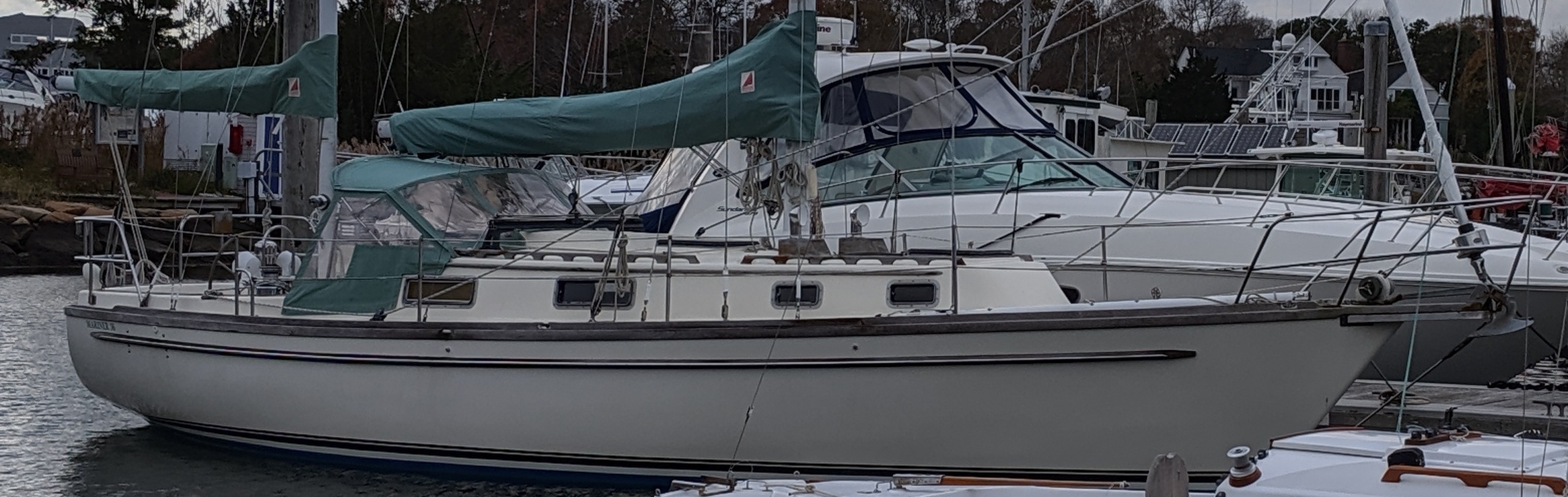
Deck, Cockpit, Cabin and Systems Drainage
Quite a bit of plumbing is related to draining water out of the boat. This includes deck drains, cockpit drains, bilge pumps, gray water disposal, cooling water, and though not a drain, the washdown plumbing is covered on this web page. Rather than having a large number of dedicated through hulls a lot of this drainage will exit the boat through a common drainage system at the transom.
Transom drainage
The transom drainage, sometimes referred to as the gutter, will exit the boat through two 2" through hulls near the centerline on either side. Since these will be above the waterline they will be stainless steel. They will have seacocks. There is a third through hull at the bottom of the transom that was previously used for the diesel engine exhaust. This will either be removed and glassed over or a third stainless steel through hull with seacock added. Above the seacocks will be short hoses and then a fiberglass structure, narrow at the bottom and widenning at 45° on each side. The 45° angle is so that water will drain at any angle of heel (heel is not expected to exceed 30°). At the very top of this structure, the gutter, will be a pair of dorades internal to the boat for two existing cowl vents. There will also be space to connect up to four either 3" or 4" air vent hoses benefiting from the same baffles used by the dorades. Below the air vents will be room for up to six ¾" (or smaller) hoses. These are for the refrigeration cooling water drain, the A/C and heat cooling (or heating) water drain, the watermaker excess water outlet, and possibly to empty the gray water tank on demand. Below that will be two 1⅛" hoses and two 1½" hose for bilge pump and possibly two 1½" hoses for new aft cockpit drains.
Each 2" through hull for drainage provides 4 inch2 (sqin) of drainage. For either 2 or 3 this is 8 sqin or 12 sqin. A 1½" hose has 2.25 sqin area, a 1⅛" hose has just over 1¼ sqin of area and a ¾" hose has less than ⅝" area. Both cockit drains, plus all four bilge pumps is about 11½ sqin total. If three 2" through hulls are used (and not blocked) the transom drainage can't overflow.
Deck drains
Deck drainage is primarily over the sides but there are two drains aft. These currently have short hoses to small through hulls on the topsides. At some point these through hulls will be removed and hoses will be led to the transom drainage. These are ½ drain hoses. Since these drains are aft, there is a short distance to the transom drainage.
Cockpit drains
The existing cockpit scuppers drain to two 2’ hoses to seacocks and through hulls well below the water line. The cockpit itself is sloped so that water drains forward. This provides substantial drainage.
Even though the cockit slopes so that water drains forward it would be helpful to have additional cockpit drain capacity in case the boat was boarded by wave over the stern (aka pooped). Two additional 1½" scuppers may be added aft. From there it is a short distance to the transom drainage.
Bilge pumps
There is currently one manual bilge pump with a 1½" hose. There had been a small electric bilge pump with ¾" hose but since this was very limited capacity will not be used. There will be one 12V bilge pump in the forward cabin with 1⅛" hose, another 12V bilge pump with 1⅛" hose in the middle of the main bilge. Just forward of that pump will be 24V bilge pump with 1½" hose.
The two 1½" hoses and two 1⅛" hoses will be led through the bilge to the motor/engine compartment. From there they will turn to the starboard side under the pilot berth and exit at the back, still under the pilot berth itself. The hoses will be raised to approximately the level of the bottom of the cockpit and then to the transom drainage.
Gray water
There will be three or four small gray water tanks. These are for the refrigeration drain, the galley sink, the vanity sink and the shower. The shower and galley sink may be served by one tank. Each of these tanks hold about 2½ gallons but empty when about half full.
Each of these small tanks will pump to a larger tank. This will either be a 9 gallon tank near the bow or an even larger tank near the stern. The larger tank will be pumped out on demand to the transom drainage.
The shower is on the port side and the vanity sink on the starboard side. It might be easier to put one tank below the floorboards in the center serving both since there isn't much room under the vanity sink.
The gray water tank for the galley sink will be immediately below the sink. The gray water tank for the refrigerator drain will be below the refrigerator.
The small gray water tanks have ¾" outlet hoses. The hoses for the galley sink and refrigerator will lead to the port side of the boat and run along the port side up either to the bow tank or the stern tank. The shower or shower/vanity tank hose will run on the port side. If a separate vanity sink tank is used the hose will run on the starboard side if a bow tank is used, otherwise it will run under the floor to the port side and then down the port side.
The larger gray water tank will be emptied using a fresh water pump and strainer, most likely the Jabsco PAR-Max line of pumps with ½" hose. If the strainer clogs it will have to be cleared. The gray water tanks also have strainers which will have to be cleared. For this reason these tanks need to be reasonably accessible.
Cooling water
The refrigeration uses air and water cooling with the water cooling being much more effective. The A/C & heat uses water cooling. The cooling return lines for both will run along the port side and into the transom drainage.
Watermaker excess water
The watermaker compresses salt water to 800 psi to get the water but not the salt to pass through a semipermiable membrane. To keep the feed water from getting excessively salty excess water is dumped overboard. Fresh water is also dumped overboard when the watermaker starts up until salinity is reduced or after the watermaker has been pickled (biocide added). The excess water and initial fresh water will be routed to the transom drainage. It is a requirement that both have free flow but since the transom drainage has excess outflow capacity this requirement is met.
Anchor wash down
The anchor washdown is not a type of drainage but covered here since it is the only use of raw water that does not exit the boat through the transom drainage. The through hull and seacock is on the port side under the aft portion of the v-berth. A y-valve is used to direct this water to either the head raw water pump or to the washdown pump. The washdown pump hose passes under the v-berth on the port side, then up and into the anchor locker on the ports side along with the switch. A shelf at the top of the anchor locker extends into the cabin to hold the wash down hose.
Raw water intake
Except for the washdown pump, all raw water intake is served by a single 1½" raw water through hull. This through hull used to be used for the engine and was immediately reduced to ¾". The bronze 1½" to ¾" 90° bend has been removed.
In its place a bronze 1½" 90° bend will be added, facing forward. This will lead to a raw water strainer just behind the companionway ladder. The needs nearly 12" of height and enough side clearance to drop and remove the filter basket and strainer.
An alternate is the Groco BVS Series - Seacock/Strainer Combination. The seacock may need to be replaced and this mounts the strainer on top of the seacock with the filter removable through the top of the assembly.
Connected to the strainer there may be a 1½" NPT male to barb and some hose and then another barb to 1½" NPT male. The purpose of this is to create a turn so that the next section of bronze pipe flows from starboard to port just behind the companionway stairs.
This will lead to a 1½" tee coupler. One part of the tee coupler will go to a 1½" to ¾" pipe reducer to a ¾" nipple with check valve and then a ¾" NPT female to ¾" barb with a hose leading to the boost pump of the watermaker which has its own strainer.
The other end of the the 1½" tee coupler will lead to a 1½" to 1¼" pipe reducer, a 1¼" male to male pipe nipple and a 1¼" tee coupler. The two remaining ends of the tee coupler will have 1¼" to ¾" pipe reducer. One will lead to the refrigeration cooling water pump and the other to the A/C & heat cooling water pump. If either one needs a ⅝" hose, a ¾" male to male pipe nipple and a ¾" NPT female to ⅝" barb can be used.
This section of bronze tees has no elbows. Therefore each bronze fitting can be tightenned sufficiently but not overtightenned potentially damaging the threads. The reducing tees may point the two ¾" ports in any direction and the whole assembly, having only hose at each end, can be rotated for best routing of these hoses. The worst case is the ¾" ports are 180° from each other.
Serving multiple water intakes from a single through hull is generally not recommended but is a common practice to avoid riddling the hull with through hulls and seacocks. The reason for avoiding this is to avoid having one or more intakes starving an intake. The watermaker boost pump is the most sensitive to being starved of intake water. In this case the flow sizes are reduced so that there is more than enough feed capacity at each tee. The check valve insures that the refrigeration and A/C & heat intakes cannot create a suction on the watermaker boost pump intake no matter how clogged the through hull strainer or primary strainer gets. The strainers should be checked regularly and before watermaker use. A further precaution would be to turn off the A/C & heat, and maybe the refrigeration water pump before using the watermaker allowing the refrigeration to continue to run temporarily using air cooling.