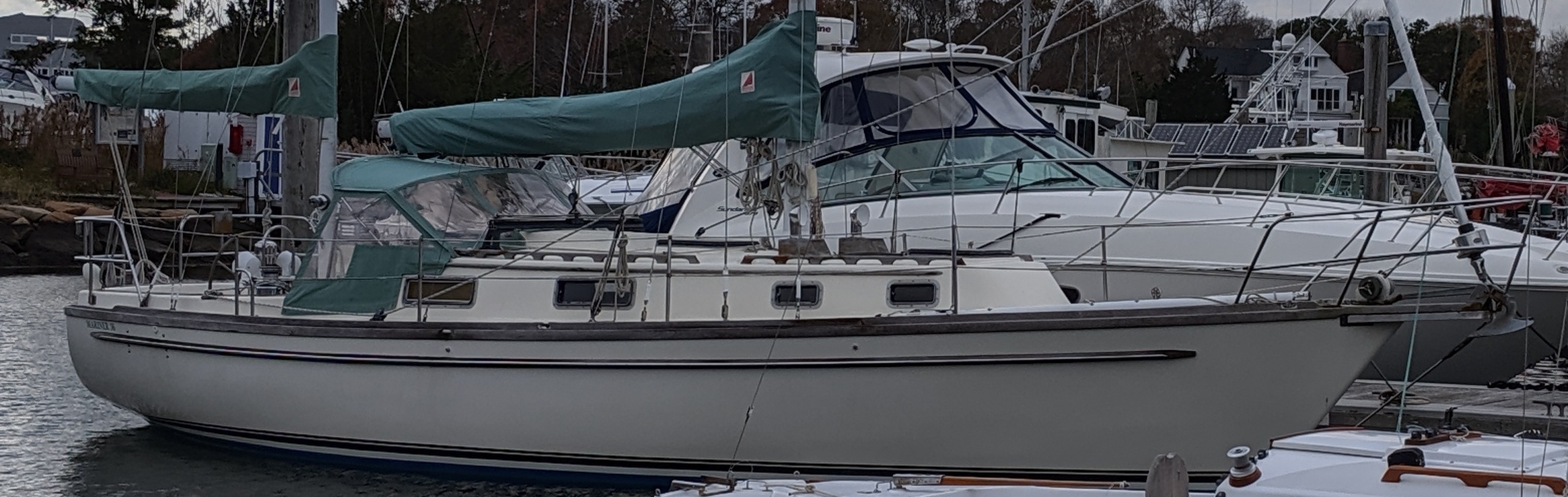
Low Amperage Panel and Breakers
A new teak enclosure will be made with a constant depth rather than sloping and deep toward the bottom. The new enclosure will be wider and taller to allow cables a greater bend radius at the hinge and making it easier to open the enclosure for access to the wiring.
Low Amperage Breaker Panel Wiring
Due to the use of 24V and 12V battery banks and circuit groups prioritized using battery protectors, multiple panels will be used. The battery switches will be located elsewhere and no analog meter will be used.
Blue Sea makes two small panels with two columns of breakers, with LED indicators on each breaker. Both are rated for 12v or 24V. Each column has a separate simple bus bar which need not be used. If the provided bus bar is removed then depth is reduced slightly and the breakers are can more easily be changed. The Blue Sea 8096 has two columns of three rows each for six total breakers. Dimensions are 10½" wide by 3¾" high. The panel overlaps by ¼" on each side and top and bottom so requires a 10" wide by 3¼" high cutout. The Blue Sea 8385 is similar with four rows for eight total breakers and is 4½" high. Both are 2½" deep.
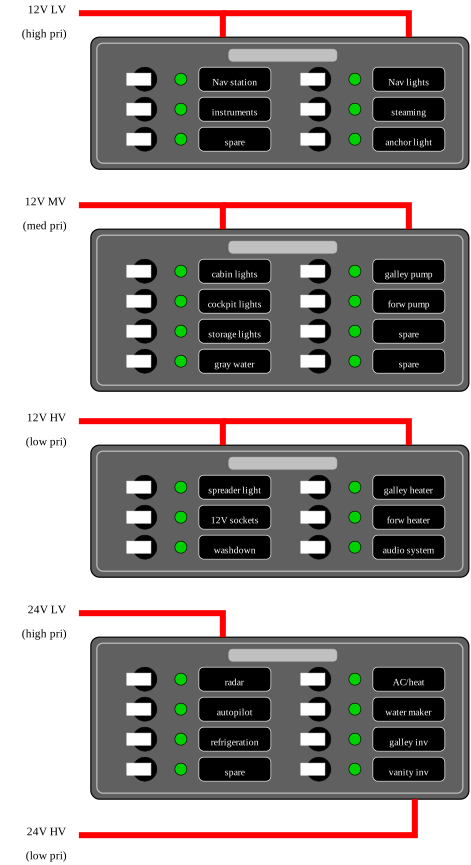
The allocation of breakers is shown in the illustration to the right. Only 15A breakers are used. If a load requires higher current a solenoid will be used and a thermal breaker will provided for the load on the high amperage breaker panel. For these high amperage loads the 15A breaker serves only as a switch for the load.
Many panels in other boats are wired with both positive and DC ground with per circuit DC ground wires from the panel. In some installations this serves a purpose, avoiding having the positive and DC ground wires taking different paths and potentially creating a magnetic field which could affect the compass. Minimizing this magnetic field is accomplished by running load wires back through the same path that the bus wires were run to a point where both positive and negative wires can be run in parallel.
The existing panel is separated from the very large area behind it by a small gap between the bridgedeck seat and interior cabinetry. Not bringing high amperage ground wires through the same restricted space means positive feed current passes about 18 inches to the panel, then 18 inches back without corresponding ground current. Very small ground wires will be available but used solely to provide ground to the LEDs in the panels themselves. Since the panel bus and load wires are close together and in parallel no significant magnetic field should result.
The existing wire paths back through a very restricted space will not be used. The wires will be run through the back of the small cabinet under the bridgedeck and above the companionway stairs. There is much better space for wiring on the starboard side and the starboard side is also where the high amperage breaker enclosure will be mounted.
A set of terminal blocks will be placed in the area where the breaker panel load wires reach the starboard side. A total of 28 wires from the panel (number of breakers including spares) will have ring terminals to connect to these terminal blocks. From these terminal blocks the loads will be bundled into common runs to the various parts of the boat where the loads reside. A ground bus bar can be placed near these terminal blocks so the ground path will be the same. Rather than individual ground wires, a larger ground distribution wire can be run in parallel to feed runs to avoid creating magnetic fields. The Cabin Wiring Plan web page provides further details.
The chartplotter at the helm will be enabled with the instruments switch. The chartplotter in the Nav station will be enabled with the Nav station switch. If not needed each chartplotter can be powered off at the chartplotter. The steaming light switch will be wired off the Nav lights so that the steaming light cannot be turned on without the Nav lights. Individual lights will have switches outside of this panel.
At anchor instruments can be left on in order to produce an alarm on a significant wind shift or if the GPS detects the anchor dragging. The helm GPS might need to be left on to produce GPS. If the display blanks very little power will be drawn. Alternately an independent GPS can be provided. The AIS and/or VHF may have a GPS but the AIS may draw more power than needed for GPS only and should not be powered on if it insists on broadcasting when powered on. In a rough anchorage having the VHF on might be a good idea. The existing VHF does not have a GPS and is not networked.
Low Amperage Enclosure Dimensions
The new enclosure can be made larger than the original. It needs to be made taller and a little wider to hide damage.
The enclosure will have a hinge at the bottom to provide access to the back of the panel for maintenance. Both enclosures will have a door with a tempered glass or polystyrene window (plexiglass or lexan) that is hinged at the top. A hook and eye on the headliner will hold the door open for routine access.
The 6 breaker and 8 breaker panels are both 10½" wide. The new enclosure will be 13½" wide. The frame is ¼" wide so ½" is lost to the framing. This leaves 1½" on either side of the breaker panels. Inside the excess spaces on either side four bus bars will be located plus one at the top of the enclosure. Only AWG #10 wires from these bus bars will have to bend with the hinge, not the AWG #6 bus wires to the bus bars.
The 6 breaker and 8 breaker panels are 3¾" high and 4½" high respectively. There are two of each of these for a total of 16½" of height. There will be ½" space between panels and ½" below the bottom panel. There will be 2½" above the top panel. This additional height hides the holes for the prior latches above and below the original enclosure plus provides plenty of room for the fifth bus bar.