Head and Black Water
Some people find the workings of the head and the black water system to be unpleasant topic. Every boat owner that goes to sea will eventually have to deal with a problem. It is adventageous to design the system well and know it well to at least reduce the number of occurances of fixing the head or black water plumbing.
Pumping overboard and holding tanks
In most or all of the US it is illegal to pump waste overboard within three miles of shore or in zero discharge areas such as marine sancuaries. Similar restrictions exist in Europe and many other places. No boats should be pumping overboard at a marina, on a mooring, or at anchor. This is mostly unenforced so many boat pump overboard regardless of where they are.
When not offshore waste is supposed to pumped into a holding tank and when the tank is becoming full free pumpout facilities should be available, either at a dock or by calling a pump out boat. The reality is that pump out coverage is poor in many places. Boats would have to travel a distance to reach a pumpout facility. This inconvenience plus the poor enforcement of restrictions on pumping overboard leads to non-compliance with restrictions on pumping directly overboard.
Another means of emptying the holding tank is to go far enough beyond shore where pumping out is legal and pump out the tank there, without having to make arrangements with a pump out facility. Either an electric pump can be used or a manual pump.
Typical black water plumbing
Most black water system pump from the head through a high vented loop to prevent back siphoning, and then to a Y-valve. The Y-valve can direct the waste either overboard or to the holding tank. The holding tank always has a vent. The holding tank will have a hose attached near the lowest point in the tank. This hose may have a Y-valve leading to either a waste deck plate for pump out, or to an electric or manual pump and then overboard.
Although this is simple, quite a few things can go wrong with this plumbing. The waste hoses must be marine grade black water hoses to reduce odor. These hoses are only 1½" in diameter and so are prone to clogs. This is made worse since urine and salt water leave behind hard mineral deposits that gradually reduce the effective hose volume. Back siphoning can occur if the vented loop is not mounted high enough or if the one way vent clogs. The tank can also accumulate mineral deposits. Hose or fitting leaks can occur. If allowed to freeze the tank or other plumbing can rupture.
Types of head (aka MSD)
The head itself is a critical component. There are a few types of pumps: diaphram pump, reciprocating piston pump and electric centrifigal pump with macerator. Diaphram pumps and reciprocating piston pumps are both types of positive displacement pumps. The head can also use either freshwater or raw water.
Some toilets are able to switch sources from fresh water to raw water with the flip of a switch. A simple Y-valve would not solve this as the fresh water is presurized and uses a solenoid and the raw water is not pressurized and requires a pump. The Raritan Sea/Fresh option on most of their high end toilets offers this ability.
The option to use fresh water to raw water with the flip of a switch can be retrofitted to any toilet that offers both fresh and raw water options using similar components. On the fresh water side a check valve near the toilet is needed along with a solenoid. On the salt water side the pump is needed. The switch just enable one or the other. For example Jabsco offers two kits to convert fresh water from/to raw water. The only other thing needed is the switch. All other installation requirements have to met such as installing a vented loop on the raw water side if the head is ever lower than the raw water intake which is almost always the case on a monohull.
Types of head pumps
Head diaphram pumps are usually manual but some are electric with the option to operate manually if there is no electricity or the motor isn't working. The diaphram pumps suck waste and water into a chamber and then push it out of that chamber. For this to work there has to be two working valves. These are usually flapper valves or joker valves. If anything blocks either valve from closing the pump will stop working and will need to be disassembled and cleared.
Reciprocating piston pumps are not often used as head pumps. They are similar to diaphram pumps in that they draw a vacume to fill a chamber, then push the waste out, and rely on two valves. The reciprocating pumps also rely on the piston seal.
The centrifigal pump with macerator puts the macerator on the same shaft as the centrifigal pump vane assembly. The macerator is on the inlet side and has sharp blades to chop up waste. As long as nothing goes into the toile that wasn't eaten plus a small amount of toilet paper, the macerator and pump should not clog. The macerator greatly reduces the frequency of hose clogs and there are no flapper valves or joker valves to get stuck open.
The centrifigal pump with macerator should require much less frequent disassebly. If something is put in the toilet that stops the macerator then disassebly will be required. The motor could also need repair or replacement, usually after many years of use.
Fresh water vs raw water
Fresh water is a precious commodity. On a boat without a watermaker raw water may be the best option unless the boat will always have access to a plentiful supply of fresh water at low or no cost.
Marine toilets often smell even if regularly cleaned. Good quality head hoses and holding tank reduce odor but don't entirely eliminate it. If using raw water, much of that odor is from the raw water itself, mostly dead algea. Using fresh water intake will eliminate this and eliminate most of the odor in the first place. A second benefit of using fresh water intake is that it eliminates the mineral deposits caused by mixing urine with salt water.
Space limitations
Standard domestic toilets are 17" high. Houses don't heel 30° away from the toilet but boats do (monohulls). At this angle it might be better to have a shorter toilet. If the toilet is mounted on a pedestal rather than flush mounted to the floor, then that height will need to be subtracted. Marine toilets come in various heights, mostly 17", 14", tall which are greater than 17" and some compact toilets are under 14".
For installations where the toilet back is against the hull there may be limited space for a long toilet. Many toilets have either a motor that can be rotated 90° (some Jabsco and other manufacturers) to reduce length or have a very flat motor (some Raritan toilets). Some have the motor mounted vertically with a belt drive to save space.
For all but very small boats or unusual installations, width of the head is generally not a problem. The electric units generally are narrower than a toilet with a manual pump mounted to the side of the toilet.
Another consideration is hose runs and maintenance access. Some of the high end toilets hide the hoses and wires. These usually assume that the hoses will exit the bottom of the toilet or the back. If the back of the toilet is against the hull rear hose exit is not an option. If the toilet is mounted on a hollow pedestal then there will be limited space below the head. For this type of toilet the hoses and wires need to be connected and then the toilet lowered into place and secured with bolts. This means that for any maintenance the toilet has to be unbolted, raised, and may need to be disconnected from hoses.
The 1½" discharge hoses are particularly difficult to bend. The ½" fresh water or ¾" raw water hoses are less difficult to bend but still quite inflexible. The hoses can snake under the head to take up slack that is needed when the toilet is raised to install or access later.
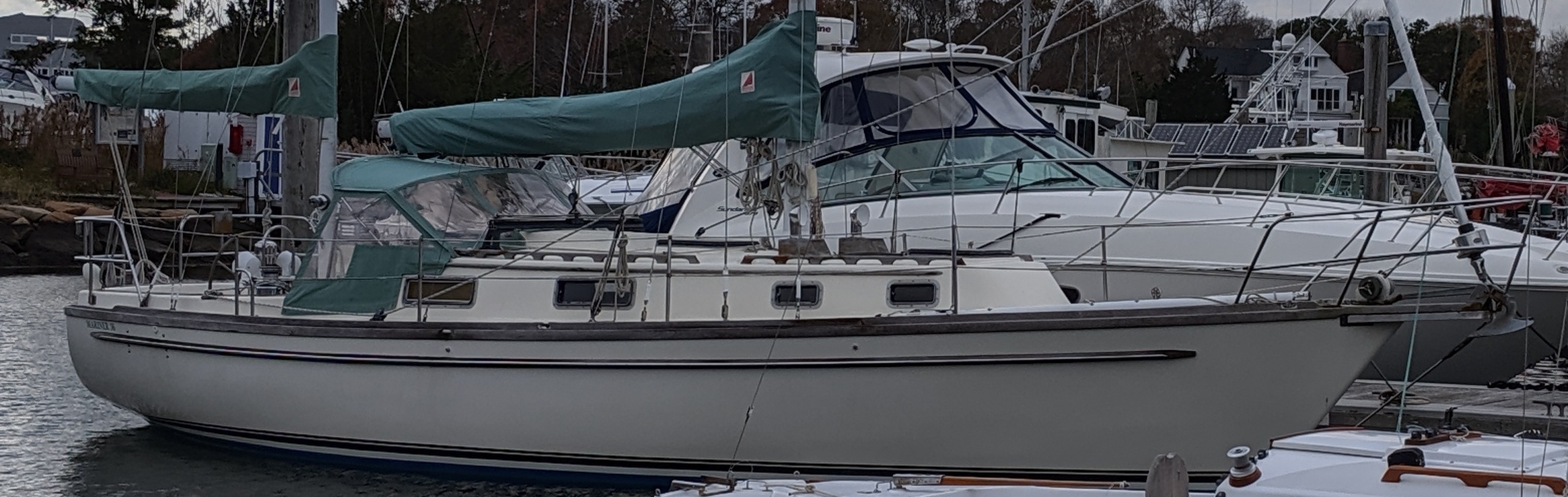
The Mariner Yacht 36 has the toilet mounted in the molded fiberglass shower enclosure against the hull on the port side. Neither width or height is a problem. The shower floor is 28½" wide and 20½" deep. A pedestal extends 6" in height and a 6" distance forward. At the forward end of the shower there is no room at all in that cavity. The enclosure then slopes at 45°, 10¼" back and 10¼" up. The 20½" plus 6" pedestal plus 10¼" sloping section adds up to 36¾". The the shower enclosure was measured at 35¼" deep but excluded some wood trim which adds 1½".
A 14" high toilet would be 20" off the shower floor, a bit high but reasonable. The pedestal can be extended forward a small amount to accomodate a toilet that is too long at the base. One way to do this is add a ½" or ¾" board that extends forward and glass it in, possibly putting a knee under it. This would add slightly to the height and being 45° also add slightly to the depth. Toilets with a long rear mounted motor usually need 14" to 15" and will be too long. Some of these allow the motor to be rotated 90°. Some of the toilets are offered with an angled back and need under 11".
The added intrusion into the shower are is a concern. For example, the Raritan Elegance toilet with sloped back extends 18⅜" forward and is angled to reduce depth by 2⅛". The front would extend 10¼" forward from the existing pedestal and reduce the shower floor depth directly in front of it from 20½" deep to 10¼" deep, cutting it in half.
Some of the toilets with motor assemblies that can be rotated 90° take up less depth at the base. For example Raritan Elegance with sloped back takes 10⅛" depth while Raritan SeaEra QC takes up 6⅝" depth. A ¾" board glassed over the pedestal would allow the Raritan SeaEra QC to be mounted without extending the pedestal out at all. The back of the toilet extends under 7⅛" and forward less than 3⅝" reducing the shower floor depth to 16⅞" deep, rather than to 10¼" deep with the Raritan Elegance.
Toilets Considered
The Raritan Elegance and Jabsco Deluxe Flush both enclose all of the plumbing in the base and slope back to reduce depth at the base. Raritan Elegance 10⅛" depth while the Jabsco Deluxe Flush takes 10½" depth and would need to have the pedestal extended slightly more forward. The Jabsco Deluxe Flush is sloped back more to bring the back 4" back rather than 2⅛" for the Raritan Elegance. The Jabsco Deluxe Flush is also not as long at 17⅝", extending forward 7" from the existing pedestal, reducing shower floor depth to 13½" rather than 10¼" for the Raritan Elegance. This is a 3¼" improvement.
The Raritan SeaEra QC Compact Marine Toilet and Jabsco Quiet Flush E2 Compact Bowl Toilet are both compact toilets which allow their motor assembly to be rotated 90°. If the base on the Raritan SeaEra QC is rotated counterclockwise the exit hose will point back but be farther from where it will exit the enclosure. If the base is located clockwise the exit hose will point forward into the shower area. The Jabsco Quiet Flush allows the discharge pump to be rotated 180° which allows the base to be rotated clockwise with the hose pointing back. This may be a mute point if the hose needs to point forward due to limited space for the hose back. This appears to be the case for both toilets since the discharge tube houses a joker valve adding length. Both Raritan and Jabsco offer a 90° discharge port/fiting reducing the intrusion of the hose.
The Jabsco Quiet Flush E2 base is 7.14" wide which is just over 7⅛" wide. The pedestal would have to be extended forward but if using ¾" board ½" would be enough. The bowl is about 16¼" long and extends back 5¾" into the 10¼" sloped space. The intrusion into the shower area would only be 3¼" which is very slightly less than the 3⅝" for the Raritan SeaEra QC.
The Raritan SeaEra QC is available in raw water, fresh water, or Raritan's SeaFresh which allows a switch between raw water and fresh water. The Jabsco Quiet Flush E2 does not have that option, however only a few components are needed to convert a raw water toilet to use either raw water or fresh water.
The raw water version of the Jabsco Quiet Flush E2 has a raw water strainer and a self priming remote raw water pump. This is a diaphram pump. The fresh water version comes with a solenoid with integrated double non-return valve and anti-siphon vacume break. To build your own toilet that can accept either raw water or fresh water all that is needed is these components, plus a tee connector, a backflow valve for the salt water side, and a SPDT electric switch. The new backflow valve prevents fresh water from flowing through the salt water pump and out the seacock.
The Jabsco Quiet Flush E2 fresh water and salt water versions are the same price. The pump goes for about $220 and the strainer is about $30. The solenoid assembly costs about $190. It is slightly cheaper to buy the raw water version and convert to toilet that can take raw water or fresh water. A switch costs about $8-30 depending on how fancy it needs to look. A tee costs about $11.
A potential problem with the Raritan is the integration of fresh water components into the end of the motor assembly cover. One side will be facing the sloped part of the shower enclosure where there is very little room. The Jabsco solenoid is separately mounted in any convenient location.
The slanted back toilets are more attractive but harder to install and will be harder to service. Their main disadvantage is their significant intrusion into the shower space. Of the two toilets with motor assemblies rotated 90° the Jabsco intrudes the least, about 3" less than the Raritan.
The Jabsco Quiet Flush E2 Compact Bowl raw water toilet costs under $800. Conversion cost is under $250. The Raritan SeaEra QC with SeaFresh option costs about $1,300 depending on which display/switch is chosen. The best display/switch integrates with either of two optional Raritan holding tank monitors. The sea water strainer is optional but necessary and therefore adds to the cost. This is a difficult choice. Current leaning is toward the Jabsco Quiet Flush E2 but it may take a visit to a boat show to see both in person to make the decision.
Black water plumbing
The existing 22 gallon holding tank is under the v-berth. The head is on the port side. The through hull on the port side for direct discharge has been removed and the hold glassed over. There is a through hull on the starboard side to empty the holding tank.
The head is in the shower enclosure. The head hoses exit on the right side (looking into the shower). The hoses are led into cabinetry with drawers and more than adequate room for the plumbing. The head hose heads up in the back of this cabinet into a more shallow cabinet with a door where there is a vented loop. From the vented loop the hose leads directly to the holding tank.
The vented loop can't be higher that 4’ above the head since that is the limit of the macerator pump lift. The vented loop should be higher than the holding tank at any reasonable angle of heel. If this is not possible, putting a vented loop on either side of the holding tank is an alternative, since one of the two will be above the holding tank. The limit of 4’ lift is itself a problem since the holding tank could be more than 4’ above the toilet if heeled to port.
From the bottom of the holding tank a hose leads to a y-valve. One side of the y-valve leads to the pump out deck plate. The other side of the y-valve leads to a manual waste pump, which may at some point be replaced with an electric bilge pump, and then to the seacock and the through hull.
The raw water seacock should go to a vented loop but currently does not. As originally plumbed it went to a tee with the anchor wash down pump and then to the head. The original toilet had a manual pump and therefore pumped raw water manually. The tee will be replaced with a y-valve. The y-valve will lead to the head's raw water pump and then to a vented loop and then the tee that adds either fresh water or salt water to the head.