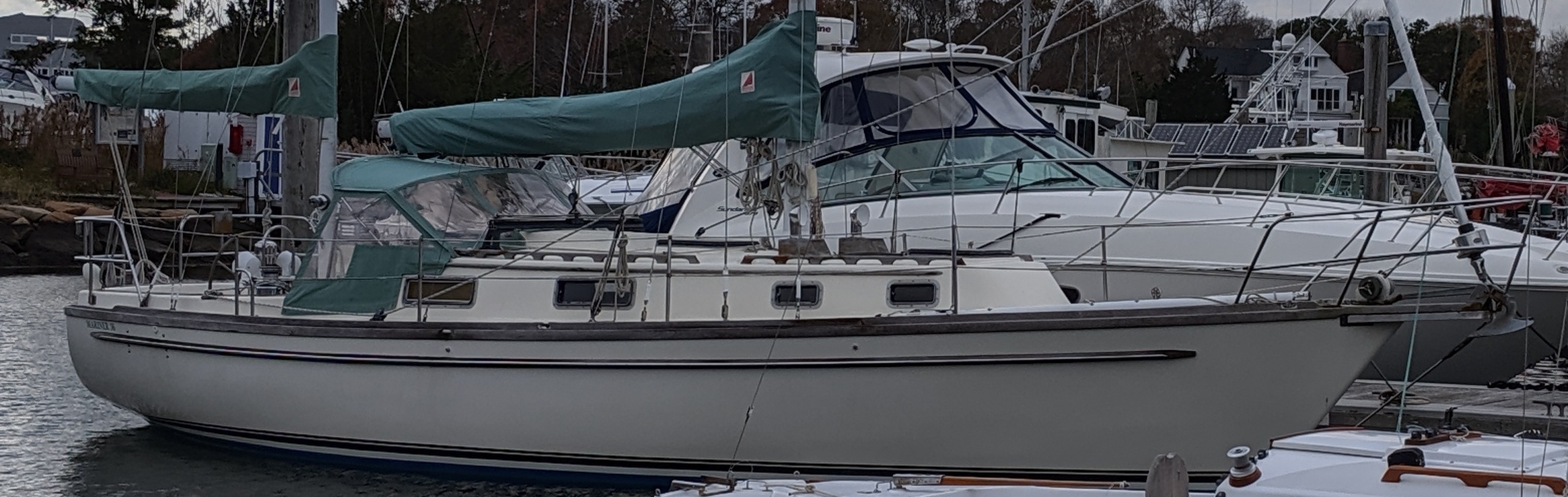
The sailing vessel (sv is the USCG abbreviation) named Fully
Charged is intended to be a fully renewable energy powered vessel
after a refit is completed. The auxiliary propulsion will be
electric rather than diesel. The galley stove will be induction
and electric oven rather than propane. The dinghy motor will be
electric rather than gasoline. The primary charging sources will
be solar panels and a wind generator. Auxiliary propulsion regen
may contribute some charging. Hopefully there will be no need for
a portable generator for backup charging. The use of a genset has
been ruled out due to available space.
In November 2019 a 1980 Mariner Yachts 36 was purchased with the
intention of doing a major refit over the winter and the next few
seasons. The
2019 Purchase of Mariner Yachts 36
web page describes the purchase itself.
As the work progresses a set of web pages will be updated that
summarize plans, work in progress, completed work, and overall
status.
This web site will be updated during the refit but some time after
the refit is completed the
Completed Work
web page and the
Planned Upgrades
web page will see very few updates. The focus will change to
sailing and ongoing maintenance. At the current (very slow) rate
of progress that transition won't happen for a very long time.
This web site can be accessed using the top menu bar and the pull
down menus. For pages that have subpages, the subpages will be
listed at the bottom of the page as well as available on pull down
menus.
The rest of this page serves as a site map but at this stage also
helps to organize content and prioritize changes as the web site
evolves. The web site is still very much a work in progress in
fairly early stage. Below is a list of web pages and an
indication of their status with the list organized by the pull
down menu hierarchy.
The meanings of the status indications on the pages is provided below
(Status: Archival)
No need for change to the web page is
anticipated on a page marked as archival. This designation is
usually for web pages that document past events or document
completed work.
(Status: Completed)
A web page marked completed is thought to be
complete and accurate but may change in the future. If longer term
work is planned, updates will be needed when that work is
undertaken.
(Status: Accurate with Ongoing Edits)
A web page marked as accurate is accurate and
mostly complete but expected to change. Change may be due to work
in progress or due to planned near term work. Change may also occur
on web pages that document events other than boat work. In either
case edits may be ongoing.
(Status: Incomplete)
A web page marked incomplete is mostly complete
but may have missing information, information that needs to be
updated or at most incomplete sections.
(Status: Placeholder or Outline)
A web page marked as a placeholder may have
little or no information or may be just an outline of planned
content.
(Status: Temporary)
A web page marked as temporary is intended to go
away but may have useful information intended to be used in other
pages or in new pages.
The web site is still very much a work in
progress in fairly early stage. The site map is automatically
updated as the organization of the site changes.
This page is just an empty skeleton. Not much has been
completed. Quite a bit of equipment has been purchased but has
not yet been installed. This set of pages will be updated as
progress is made
The marine survey completed prior
to purchase is in the past. At this point a summary
of findings is provided, but not the survey itself.
If the surveyor is OK with putting up the complete
survey, then that will be added.
This page is historic and has
little need to be updated. The purpose is to take
notes on the condition of the vessel and some
important measurements at the time of purchase.
Updates will include additional measurements and
more accurate measurements as they become available.
Many pages describing planned work link back to this
page due to the dimensions recorded here.
This page describes the decision
process when purchasing the batteries. Prices are
given and a month given in a chart heading which is
easily overlooked. More prominent indication of the
date of the pricing should be provided.
This page contains a snapshot of overall plans. As plans change
or as work progresses this page needs to be periodically checked
for accuracy and updated as needed. As plans are completed pages
will be moved under the "Completed" heading.
This page describes the
measurements and the placement of a solar panel
mount. Due to the tight fit relative to the boom and
traveller, final measurements will have to wait for
the masts to be raised again. References to other
pages provide detail.
There is patchwork of
incompatible and expensive commercial monitoring for
battery, charging, load, navigation and instruments.
As a result, DIY solutions are needed. These DIY
solutions are discussed here.
Based on ABYC wiring
recommendations a plan for wire sizes is provided.
The goal is to keep losses well under 3% and
accurately determine loss where there are wire
lengths of multiple AWG gauge.
A circuit diagram is provided for
all high amperage wiring, including bus bars,
bettery switches, large breakers and fuses,
solenoids, shunts and charging sources.
This page documents the selection criteria for the
electric auxilliary. Installation is covered in
another page that is referenced. The page needs
minor update to reflect the purchase of the
motor.
Propane and alcohol stoves
pose a danger plus alcohol stoves produce too
little heat. Propane and alcohol are hard to
get in remote places and impossible to get in
tropical atols. Using an induction cooktop and
electric oven also preserve the goal of using
no fossil fuels.
The refrigeration page
discusses selection of electric refrigeration.
It does not yet cover installation. The ice
box will need to be removed and reduced in
size and then reinstalled, making this a major
undertaking.
This page describes the
possibility of adding a small reversible heat
pump AC/heat system. Some of the available
heat pumps are described. Products change so
this is is a moving target. AC/heat is
unlikely to be installed for a year or two at
the earliest.
This page describes options
to improve communications particularly when
off short. Traditional VHF & SSB are
discussed. AIS is discussed. Satelite
communication for Internet connectivity and
mobile phone over Internet are discussed. No
concrete plan exists at this point.
This page summarizes plumbing systems including the
fresh water tanks and system, the salt water
plumbing, the gray water and water water systems and
drainage.
Deck drains and cockpit
drains simply gravity drain overboard. The
cabin itself is drained using bilge pumps.
Some systems drain cooling water. Gray water
is collected in tanks and drained overboard on
demand. Raw water intake is also
covered.
The head will be replaced
with an electric head with mascerating pump.
The head will only drain into the holding
tank. The holding tank can be pumped out or
drained overboard, where legal to do so, on
demand.
At this point the refit is in progress
and there are no sailing adventures to be reported, not
even a shakedown cruise. That this page even exists is an
artifact of optimism.